
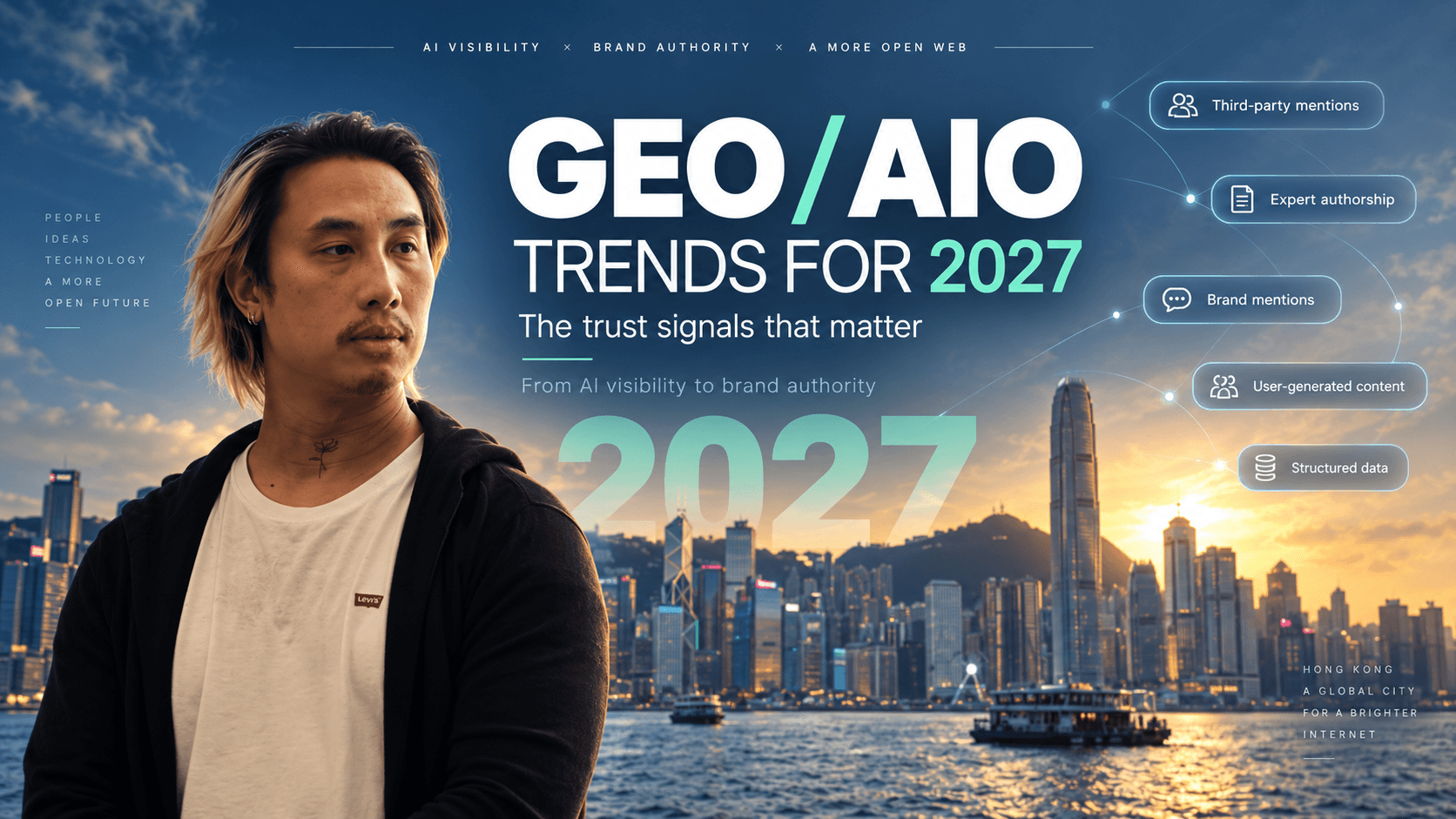
This is precisely what we are seeing when combining SEO, GEO and online reputation management: visibility is no longer built on a single playing field.
It is now created at the intersection of a website’s technical performance, the way AI engines understand and cite a brand, and the broader perception of that brand across the web, including reviews, mentions, third-party content and online reputation.
The signals that really matter in 2027
Recent data on how AI engines assess and weigh their sources of trust confirms a clear trend: some signals are becoming increasingly important, while others are becoming secondary.
Third-party mentions
Third-party citations remain one of the safest and strongest signals.
Whether on Google AI Overviews, ChatGPT, Gemini, Copilot, Claude or Perplexity, being mentioned by recognised external sources remains one of the highest-rated criteria across AI engines.
This forms part of the foundation of E-E-A-T: Experience, Expertise, Authoritativeness and Trustworthiness, the framework that continues to shape how trust is attributed to a brand, whether by a traditional search engine or a generative AI system.
Content written by expert authors
Expert authorship is becoming a central signal.
Content signed by an identifiable author who is recognised in their field, supported by a clear biography and a proven publication history, directly strengthens E-E-A-T signals.
It is one of the highest-rated criteria across nearly all AI engines.
Working with genuine experts to produce or co-author content is therefore no longer simply an editorial consideration. It has become a visibility lever in its own right.
Brand mentions
Brand mentions are becoming almost as important as links.
Being explicitly mentioned in an article, comparison, publication or AI-generated answer, even without a backlink, sends a brand-awareness and authority signal that generative engines are increasingly capable of understanding and using.
Increasing brand mentions across media outlets, specialist directories and third-party content is therefore becoming just as strategic as traditional link building.
User-Generated Content (UGC)
UGC is gaining importance in the way AI systems determine which brands to recommend.
Customer reviews, real-world experiences and community discussions directly influence the perception an AI system develops of a brand before deciding whether to cite or recommend it in a top 3, top 5 or top 10 list.
Encouraging and structuring this UGC, through reviews, testimonials and discussions, is becoming a dedicated component of a GEO strategy.
Link building
Traditional backlinks are losing some of their relative importance, although their weight still varies significantly between AI engines.
Some engines continue to give backlinks a meaningful level of importance, while others place much less emphasis on them.
Link building therefore remains relevant for traditional SEO, but on its own, it is no longer sufficient to guarantee strong visibility or citations within AI-generated answers.
Structured data
Structured data and community engagement remain among the most unstable signals.
Their importance varies significantly from one engine to another, making them some of the least predictable levers at present.
However, they also represent areas where brands that have historically neglected them may still have substantial room for improvement.
What this means in practical terms for brands
The right approach is not to try to optimise every signal at the same time.
Instead, brands should identify their weakest signal and strengthen it first, rather than continuing to overinvest in an area that is already performing well.
Statistically, moving a weak signal to a strong level can have a greater impact on overall visibility than further improving a signal that is already highly developed.
In 2027, the question will no longer simply be:
“Are we ranking well?”
It will become:
“Are we understood, cited and recommended by search engines, users and AI systems?”
Brands that begin strengthening their trust signals today will have a significant head start.